
Addressing Gettysburg Book Club
Book Review: A Little Piece of Hell at Gettysburg
Scott T. Fink. A Little Piece of Hell at Gettysburg: The Attack and Defense of the Rose Farm, July 2–3, 1863. Savas Beatie, 2026. Cloth, ISBN 978-1611217520. $34.95.
The Battle of Gettysburg has been studied at almost every conceivable level, from sweeping accounts of armies and commanders to detailed examinations of individual regiments and small sections of the battlefield. In A Little Piece of Hell at Gettysburg, Scott T. Fink narrows the focus to one piece of ground, the Rose Farm, and demonstrates just how much history can be uncovered when a battlefield is treated not simply as the setting for a military engagement, but as a place whose story began before the fighting and continued long after the armies departed.
We do not have a single favorite section of the book because what we appreciated most was the way the entire history of the Rose Farm unfolds across time. Fink takes the reader from the property and the people who called it home into the brutal fighting of July 2 and 3, 1863, and then continues the story through the burials, photographs, historical investigations, and changing landscape that followed. The Rose Farm becomes more than a location on a battle map. It becomes a place where people lived, fought, suffered, died, were photographed, and, in some cases, remained buried long after the battle ended.
The chapters dealing with the history of the Rose Farm itself are particularly valuable. Battlefield histories can understandably become dominated by troop movements, commanders, and tactical decisions. Fink’s broader treatment reminds readers that Gettysburg was also a community of farms, homes, families, and civilians. The Rose family did not choose for their property to become part of one of the bloodiest battles of the Civil War, yet the fighting transformed their home and landscape. Their experience reinforces an important aspect of Civil War history that is sometimes lost when we concentrate exclusively on soldiers. Warfare was not confined to the men carrying muskets. Civilians also experienced its destruction and lived with its consequences.
The military history remains essential to understanding why the Rose Farm became such a horrific place on July 2. Its proximity to the Wheatfield placed the property amid some of the most intense fighting of the battle. Fink provides a detailed account of the soldiers and units that moved across this landscape, allowing readers who know Gettysburg to develop a much deeper understanding of the fighting around the Rose Farm.
At times, however, the strength of this microhistory also creates one of the book’s limitations. The detailed treatment of the fighting can become so tightly focused on the Rose Farm and Wheatfield that we occasionally wanted a stronger connection to the larger struggle occurring across the Union left. More attention to how these events related to the fighting at Little Round Top, the Peach Orchard, and the Confederate brigades attacking farther north, particularly William Barksdale’s Mississippians, would help readers visualize how the Rose Farm fit into the broader Confederate assault on July 2. Some readers may also find that portions of the tactical narrative could be trimmed slightly in favor of this wider battlefield context.
For us, though, some of the most compelling material comes after the shooting stops. We especially appreciated the chapters concerning the burial and eventual reburial of Union and Confederate remains. Too often, military history follows a soldier only until the moment he falls. His death becomes a casualty statistic or a sentence at the end of a regimental narrative. Fink reminds us that death on a Civil War battlefield was not the end of that soldier’s story.
Bodies had to be identified, when possible, buried, recorded, and sometimes later exhumed and moved. Families wanted to know what had happened to their sons, husbands, fathers, and brothers. Some men buried on the Rose Farm remained there for years. Following these individuals beyond their deaths gives them an identity that casualty numbers cannot provide and helps reveal the wider human consequences of Gettysburg.
The book’s examination of the famous photographs taken on and around the Rose Farm adds another fascinating layer. These images have profoundly shaped how later generations visualize the aftermath of Gettysburg. The subsequent detective work of historian William A. Frassanito, who used landscape features and photographic evidence to correct long-standing misidentifications of where some photographs were taken, demonstrates how battlefield history continues to evolve. Photographs, burial records, terrain, eyewitness accounts, and the surviving landscape can be placed in conversation with one another.
That approach produces one of the book’s most rewarding experiences: beginning with the battlefield that exists today and working backward. We can stand on the Rose Farm, examine the terrain, study photographs and burial records, and gradually reconstruct what occurred there in 1863. The modern landscape is therefore not merely where the history happened. It is itself a historical source.
This is also why we would have welcomed a dedicated walking tour of the Rose Farm as part of the book. Fink provides readers with the people, photographs, combat accounts, burial locations, and postwar history necessary to see this ground differently. A walking tour connecting those elements to specific locations on the modern battlefield would provide a natural conclusion to the study. Readers could physically retrace the history they have just encountered, moving from the fighting to photographic locations, burial sites, and surviving landscape features.
We would recommend A Little Piece of Hell at Gettysburg particularly to readers who already possess a basic understanding of the Battle of Gettysburg and want to explore one portion of the battlefield in considerably greater depth. Fink successfully connects military history with the experiences of civilians, the treatment of the dead, battlefield photography, historical detective work, and the later history of the property. In doing so, the book demonstrates the value of microhistory. By concentrating intensely on one relatively small piece of ground, we can better understand the much larger consequences of the battle and the Civil War.
Ultimately, the Rose Farm is an ideal subject for this kind of history because its story did not end when the firing stopped. The soldiers who fell there still had journeys ahead of them. Their comrades, families, and communities continued to carry their losses. The Rose family had to live with what war had done to their property. Photographers transformed the landscape into images that shaped public memory, and later historians returned to those images and the ground itself to reconstruct what had happened.
A Little Piece of Hell at Gettysburg reminds us that a battlefield is not simply a place where something happened. It is a place where the consequences of what happened continued to unfold long after the fighting stopped.
-Colonel Steven Byers
1st Addressing Gettysburg Book Club Volunteers
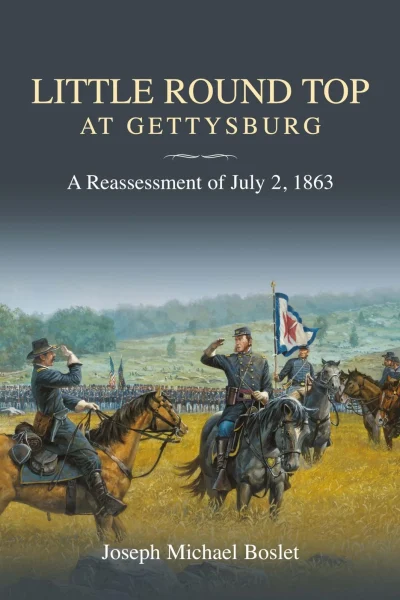
Little Round Top at Gettysburg: A Reassessment of July 2, 1863
By Joseph Michael Boslet. El Dorado Hills: Savas Beatie, 2026. Hardcover, 247 pp. $34.95
Joseph Michael Boslet’s Little Round Top at Gettysburg: A Reassessment of July 2, 1863 is not another introductory Gettysburg narrative designed for casual Civil War readers. Instead, it is a deeply analytical, terrain-centered reassessment aimed squarely at seasoned Gettysburg enthusiasts, the dedicated “Gettynerds” who already know the traditional story and are ready to challenge long-held assumptions about Little Round Top and the fighting on July 2, 1863.
Boslet approaches the subject not merely as a historian, but as a soldier. A Vietnam combat veteran, he brings to the study a perspective that separates this work from many standard campaign histories. Throughout the book, Boslet consistently reads the battlefield as a combat soldier would, through terrain, line-of-sight, exhaustion, confusion, fields of fire, and the physical realities of movement under pressure. This perspective becomes the book’s greatest strength. Rather than treating Little Round Top as a stage for legend and postwar romanticism, Boslet evaluates what soldiers on both sides could realistically see, do, and understand in the chaos of combat.
That focus on battlefield landscape is where the book excels. Boslet repeatedly demonstrates how the rocky slopes, wooded approaches, elevation changes, and broken ground shaped tactical decisions and individual actions. Readers familiar with the traditional Chamberlain-centered narrative will find Boslet less interested in mythology and more concerned with reconstructing the actual experience of combat on the hill. The result is a work that feels grounded in military practicality rather than heroic memory.
Boslet’s reassessment also broadens the story beyond the familiar focus on Joshua Chamberlain and the 20th Maine. He gives substantial attention to the other regiments and commanders involved in the struggle, particularly the men of Strong Vincent’s brigade, and carefully reexamines accepted interpretations of timing, troop placement, and command decisions. In doing so, he challenges readers to reconsider not only what happened on Little Round Top, but also how Civil War memory itself has been constructed over generations.
At times, however, the very strengths of the book may limit its accessibility. This is not a volume for someone reading about Gettysburg for the first time. Boslet assumes a significant level of prior knowledge about the battle, the units involved, and the geography of the field. Readers unfamiliar with the broader Gettysburg campaign may find themselves overwhelmed by the dense tactical discussions and detailed analysis of troop movements. This is a book written for readers who already walk the field with maps in hand and debate regimental positioning at monuments, not for newcomers seeking a general overview of the battle.
The lack of photographs and visual aids is also frustrating at times, particularly given the author’s heavy emphasis on terrain interpretation. Boslet’s analysis frequently depends on understanding subtle features of the landscape, and additional modern battlefield photographs or detailed topographical imagery would have strengthened the reader’s ability to follow his arguments. While the maps included are useful, there are moments when the narrative cries out for more visual support, especially for readers attempting to mentally reconstruct the rocky and uneven terrain of Little Round Top.
Even so, the book remains an important and worthwhile contribution to Gettysburg scholarship. Boslet’s soldier’s-eye interpretation offers a refreshing corrective to overly simplified narratives and demonstrates how deeply terrain and combat experience shaped the battle. He neither completely tears down the legend of Little Round Top nor blindly accepts it. Instead, he asks readers to reconsider the engagement with a more critical and realistic lens.
Ultimately, Little Round Top at Gettysburg deserves a place on the bookshelf of serious Civil War readers and Gettysburg students. It may not replace the classic narratives, but it successfully complicates them in productive ways. For those willing to engage deeply with the battlefield and rethink familiar stories, Boslet provides a thoughtful, challenging, and rewarding reassessment of one of the Civil War’s most iconic fights.
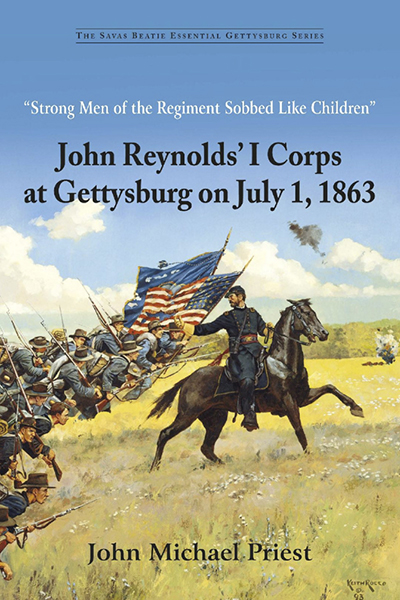
Strong Men of the Regiment Sobbed Like Children: John Reynolds’ First Corps at Gettysburg, July 1, 1863.
by John Michael Priest. Savas Beattie, 2025. ISBN: 978-1-61121-750-6
In his latest work, historian and battlefield guide John Michael Priest brings his trademark “history from the trenches” approach to the Union Army of the Potomac’s I Corps on the first day of the Battle of Gettysburg. As he does in his earlier book, Stand to It and Give Them Hell (2014), Priest examines the fighting through the eyes of the common soldiers—what they saw, what they heard, and how they felt in the midst of unimaginable chaos.
This book offers an up-close view of the battlefield; not from the perspective of generals and grand tactics, but from the men and officers in the thick of the fight. Readers are not given a distant overview of strategy; instead, they are placed directly in the action. Priest delivers a visceral portrayal of trying to maneuver around wounded and dead men and horses, abandoned equipment, scattered supplies, and surrendering soldiers. The personal view of carnage, confusion, and courage brings the battlefield to life in a way few books attempt.
Heavily footnoted and filled with meticulous detail, the narrative captures the clutter of battle…the smoke, the noise, the supply wagons, the dead and dying, the prisoners and the overwhelmed field hospitals. Priest introduces readers to the personalities of the men who fought, reminding us that while many students of Gettysburg know the monuments and the outcome, it is the experiences of individual soldiers that truly illuminate the meaning of the struggle. These human-interest stories draw the reader in and deepen the understanding of what the First Corps endured under General John Reynolds.
Readers will come away with a deeper appreciation of the ground-level experience—one that vividly illustrates the chaos that enveloped the I Corps and supporting units on July 1, 1863. They will also gain a renewed respect for the resilience of both Union and Confederate soldiers, and the humanity of all those in Gettysburg who were swept into the vortex of war.
This book is not for the neophyte. A solid foundation of Civil War knowledge is essential to fully appreciate the depth of detail Priest provides. One minor critique is the limited attention paid to the XI Corps; additional context, especially regarding their retreat on the first day, would have helped frame the broader collapse of the Union line and complemented the story of the I Corps.
Still, Strong Men of the Regiment Sobbed Like Children delivers exactly what serious students of Gettysburg seek—not just the battle, but the men who fought it. You may already know how the day ended—now read the stories of those who lived it.
~The Addressing Gettysburg Bookclub
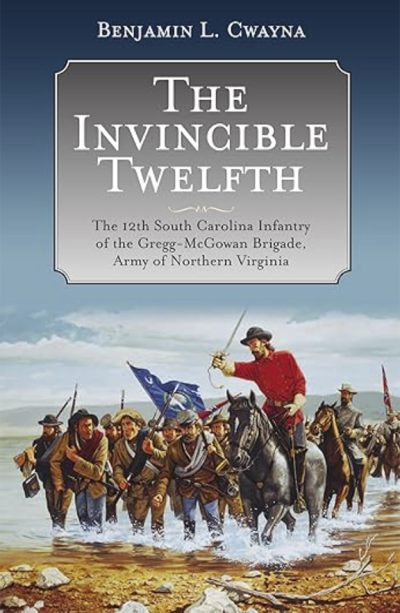
The Invincible Twelfth: The 12th South Carolina Infantry of the Gregg McGowan Brigade, Army of Northern Virginia
By Benjamin L. Cwayna. Savas Beatie, 2025. ISBN: 978-1-61121-736-0
With new regimental histories appearing every year, it can be difficult to identify those that truly elevate the field. Benjamin L. Cwayna’s The Invincible Twelfth is unmistakably one of them. Clearly written, thoroughly documented, and grounded in meticulous research, this study offers an impressive model of modern military history that blends accuracy, narrative drive, and analytical purpose.
The 12th South Carolina Infantry has long deserved a full, serious examination. Despite its remarkable combat record within the Gregg McGowan Brigade, the regiment has often received little more than brief mention compared to more widely known units such as the Texas Brigade. The scarcity of surviving letters and memoirs has contributed to that neglect. A significant number of the regiment’s officers and many enlisted men were killed during the war, leaving researchers with limited firsthand testimony. Cwayna confronts this challenge with determination, utilizing every available diary, letter, memoir, speech, and official report. His careful citations and systematic reconstruction of events give the book both authority and depth.
Rather than allowing the story to become a simple march through battles, Cwayna shapes the regiment’s service into a cohesive narrative that explains why the 12th earned a reputation for discipline, aggressiveness, and relentless fighting spirit. From its unremarkable early months in coastal defense to its emergence as one of the Army of Northern Virginia’s most dependable regiments, the book presents a clear account of how the unit developed its identity. Its performance in major battles such as Gaines Mill, Second Manassas, Antietam, Gettysburg, the Wilderness, and Spotsylvania is woven smoothly into the broader analysis. The staggering human cost of that service is never far from view. Of the nearly 1,400 men who passed through the regiment’s ranks, only about 150 remained to surrender at Appomattox.
Cwayna’s writing is crisp and accessible, which allows the complexity of the evidence to serve the narrative rather than overwhelm it. The volume’s presentation further strengthens the work. Hal Jespersen’s well-designed maps guide the reader effectively, and the selected photographs introduce faces to the names that define the regiment’s story allowing the reader to become personally invested in their story.
The Invincible Twelfth succeeds as both a deeply researched study and a highly readable account of one of the Confederacy’s hardest fighting units. It fills a longstanding gap in the historiography and demonstrates how a regimental history can balance scholarship and narrative clarity. This book deserves a place on the shelf of anyone interested in the Army of Northern Virginia or the military history of the Civil War.
-The Addressing Gettysburg Bookclub